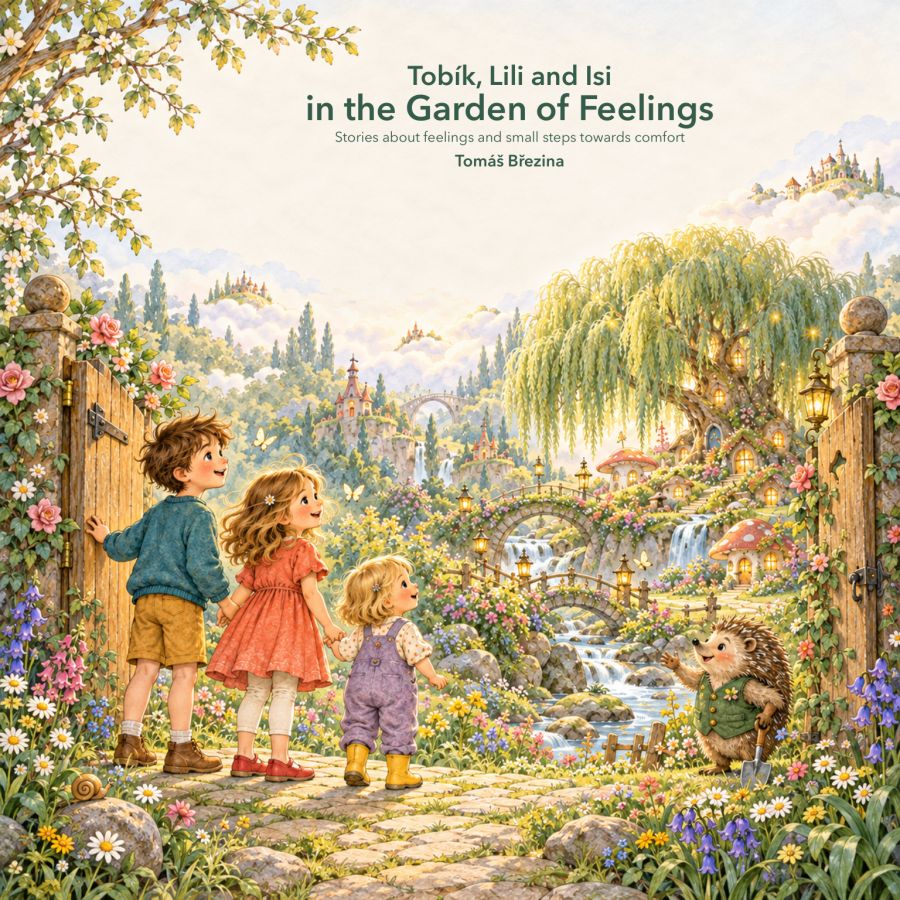
A magical garden with room for every feeling
Some days feel like sunshine. Others feel like a stone in your tummy, a bubbling dragon or a cloud that wants a cuddle. In the Garden of Feelings, Tobík, Lili and Isi discover that every feeling is welcome – and that they can ask for what they need.
Originally written for the author’s own children, this storybook follows eight-year-old Tobík, six-year-old Lili and three-year-old Isi through familiar family moments: trying something new, losing a race, feeling left out, arguing over what is fair and facing a day when everything feels too much. Mum, Dad and Bramble the hedgehog are there along the way.
Inside the book
- 14 magical adventures with full-colour illustrations.
- A short, optional activity after every story.
- 14 colouring illustrations, each on the same page as its activity.
- A simple introduction to gentle tapping and a picture reminder.
- Printable pages for drawing feelings, naming needs and identifying trusted people.
- Large, clear text, an A5 layout and clickable contents.
Read together, discover at your own pace
Designed for families with children around ages 3–8. Younger children can listen, point and colour with a grown-up. Confident readers can explore the stories themselves. Every activity is an invitation: children can choose, pause or stop.
The stories make room for difficult feelings. They show children ways to ask for help, express a need and find a safe next step. Sometimes the children try gentle tapping. Sometimes they need a cuddle, a rest or someone who listens.
What you receive
A complete 68-page English PDF, including all activities and colouring illustrations. Read it on screen or print it at home. The book uses an A5 layout and British English spelling. This is a digital download; no physical book is shipped.
All English eBooks are sold exclusively via Gumroad. Purchase this book on Gumroad to receive the downloadable PDF.
The optional tapping is loosely inspired by Robert G. Smith’s FasterEFT. This storybook supports shared reading and conversations about feelings; it is not psychotherapy or a substitute for professional care. Younger children need a grown-up alongside them.