Disclaimer: The information on this website is not a substitute for medical or psychological treatment. The content is based on personal practice and emotional work methods, not medical advice. If you are experiencing serious physical or mental health issues, please seek professional help from a qualified doctor or therapist. Emotional work is individual and results may vary.
Have you ever promised yourself that this time it would be different? That you would finally stop craving that one specific food? And yet, when the moment comes, it feels stronger than logic, stronger than willpower, stronger than reason.
According to Robert G. Smith and the principles behind FasterEFT, food cravings are rarely about food itself. They are about emotional associations. They are about what that food represents in your nervous system.
It’s Not About the Taste
When someone feels addicted to a certain drink, snack, or comfort food, it often isn’t the flavor that creates the attachment. It is the emotional state connected to it. Relief. Comfort. Safety. Belonging. Escape.
Your mind links the food with a feeling. And once that link is established, every time the feeling appears, the craving follows.
What you are really craving is not sugar, caffeine, or salt. You are craving a state.
Emotional Imprints and the Nervous System
Through FasterEFT, we understand that emotional imprints are stored experiences. They live inside the body as references. When something in the present reminds you of the past, your body reacts automatically.
If stress once ended with a soda that made you feel calm, your system remembers that. If loneliness was soothed with snacks in childhood, your body associates food with comfort.
The craving is not weakness. It is conditioning.
Breaking the Emotional Link
The real transformation begins when you stop fighting the craving and start exploring it.
Instead of asking, “Why can’t I stop?” ask:
- What am I feeling right now?
- When have I felt this before?
- What does this food give me emotionally?
Using FasterEFT techniques, you can calm the nervous system while focusing on the emotional state underneath the craving. As the emotional charge softens, the attachment weakens.
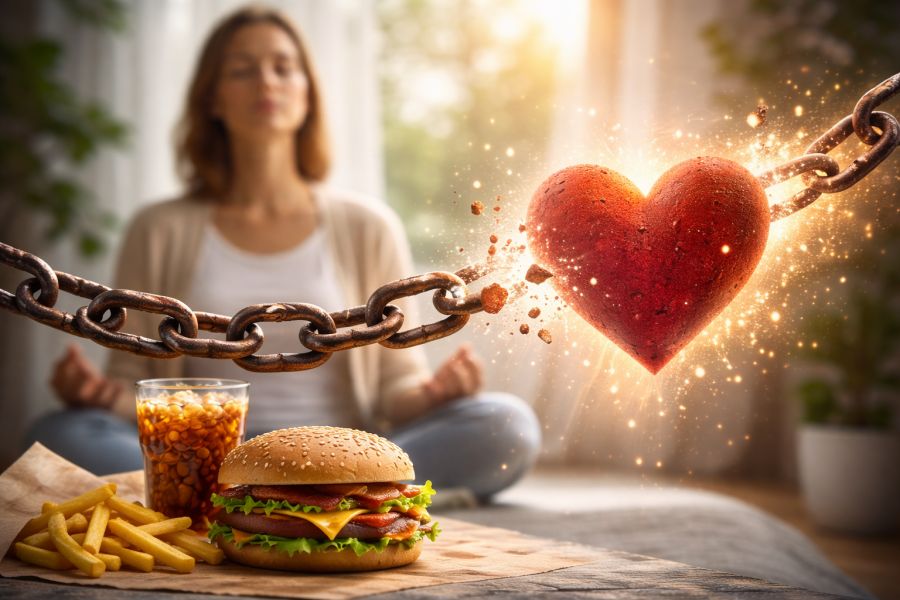
You are not removing food. You are removing the emotional glue.
Creating New Associations
Once the old emotional link dissolves, you can intentionally create new patterns.
You can associate stress with breathing instead of eating. You can associate reward with movement instead of sugar. You can associate comfort with connection instead of isolation.
This is how real change happens. Not through force. Not through guilt. But through understanding and rewiring.
Self-Love Over Self-Control
Many people believe that overcoming cravings requires strict discipline. In reality, it requires compassion.
When you stop attacking yourself and start understanding your emotional patterns, everything shifts. Freedom is not about controlling yourself harder. It is about healing what created the craving in the first place.
If you are ready to go deeper and truly change your emotional patterns, explore the tools and eBooks available in my store. They are designed to help you work with your mind, your emotions, and your nervous system in a practical and lasting way.
You deserve a peaceful relationship with food. And more importantly, with yourself.