Disclaimer: The information on this website is not a substitute for medical or psychological treatment. The content is based on personal practice and emotional work methods, not medical advice. If you are experiencing serious physical or mental health issues, please seek professional help from a qualified doctor or therapist. Emotional work is individual and results may vary.
Working with emotions does not have to be limited to moments when we have plenty of time, privacy, and a quiet place to ourselves. Stress, fear, and uncomfortable physical sensations rarely wait for a convenient moment. They appear during the working day, while traveling, before an important meeting, or even while sitting in the dentist's chair.
Robert Gene Smith, the creator of FasterEFT, therefore emphasizes that the real value of the method does not lie only in physical tapping. What matters even more is learning to recognize what is happening in our minds and consciously working with those internal processes.
Over time, the technique can become a practical skill that can be used almost anywhere—sometimes without making a single visible movement.
The Most Important Part Isn't the Tapping—It's What You Aim At
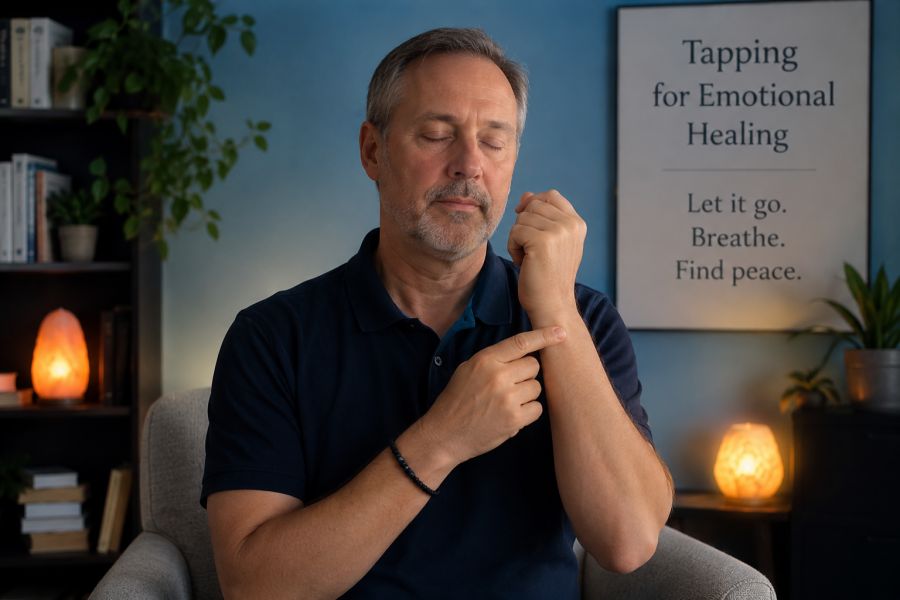
When someone sees FasterEFT for the first time, tapping on specific points of the body is usually its most noticeable feature. It is therefore easy to assume that tapping itself is the entire technique.
Robert Gene Smith, however, places considerable emphasis on something else: what he calls "aiming"—directing your attention toward what is actually creating the problem within you.
It may be a memory, an image, an internal voice, an expectation about the future, or the meaning you have attached to a particular situation. These internal processes can trigger fear, tension, or another emotional response.
Tapping then becomes a tool used while working with that response. Without recognizing what we are actually reacting to, however, we may end up working only with the surface of the problem.
Your Mind Can Create a Very Real Physical Response
Imagine that you have a dental appointment in a few hours. You are still sitting at home and nothing is actually happening. Yet you imagine the sound of the drill, remember an unpleasant experience from the past, and your body begins to respond.
Your heart beats faster. Your stomach tightens. You may begin to feel nauseous or tense.
The dentist is nowhere near you. At that moment, the reaction is not being created by the procedure itself, but by its internal representation—the images, memories, and expectations produced by your mind.
This is where FasterEFT can become useful. If we can recognize what is triggering the response, we can begin changing the way we react to that internal representation.
When Nausea Appears at the Dentist
Robert Gene Smith gives a practical example involving nausea during a dental procedure. In a situation like this, visibly tapping on your face is obviously not particularly convenient.
That does not mean you cannot work with your response.
You can notice your fear, mental images, and physical sensations. Instead of continuing to develop the internal story of "I'm going to feel sick," you can mentally use a process you have already practiced and imagine yourself moving through the tapping sequence.
The important part is interrupting the automatic chain in which one uncomfortable thought creates another until the body begins responding to a scenario produced by the mind almost as though it were actually happening.
Mental Tapping
With enough practice, some of the principles of FasterEFT can also be used mentally. Instead of physically tapping, you imagine the tapping points and move through the process in your mind.
This can be particularly useful in situations where physical tapping would be impractical or attract unwanted attention. It might be during a business meeting, while traveling, in a waiting room, or anywhere else where you want to work with your emotional state discreetly.
However, this does not mean that simply thinking about tapping will automatically make every problem disappear. The foundation remains the ability to recognize your internal response and understand what you are working with.
The Problem Isn't Always Where We Think It Is
If someone is afraid of going to the dentist, they may naturally assume that the dentist is the problem. But when they look more closely, they may discover that they are actually reacting to a specific childhood memory, an expectation of pain, or a feeling of losing control.
Two people can therefore appear to have exactly the same problem while the internal causes of their reactions are completely different.
This is why FasterEFT does not focus only on the label we give a problem. It attempts to identify the personal meanings and internal references supporting each individual's response.
The more accurately we can recognize what is happening within us, the more precisely we can work with it.
FasterEFT Is Ultimately a Skill
One of Robert Gene Smith's important messages is that working with your own mind is not something you use once and then forget about.
It is a skill that improves through practice.
The more often we notice our automatic responses, the sooner we begin to recognize them. Over time, we may notice fear before it fully develops, catch an internal dialogue before it creates minutes or hours of stress, or realize that we are reacting to an old memory rather than to what is actually happening around us.
At that point, we are no longer simply passive observers of our emotions. We have an opportunity to change our response.
It's Not About Controlling Other People
FasterEFT is based on working with our own internal processes. We cannot use tapping to change someone who does not want to change, nor can we eliminate another person's emotional problem simply by working on ourselves.
What we can change is our own response to other people and situations.
We may not be able to change the behavior of a colleague, partner, or family member. But we can change what happens inside us every time we encounter that behavior.
And that change can have a surprisingly powerful effect on the quality of our lives.
Change Begins Within
Stressful situations will not disappear from life. We will still visit the dentist, deal with problems at work, encounter difficult people, and face uncertainty.
What we can learn is how to recognize what is happening inside us during those moments.
The real power of FasterEFT may not lie in the physical act of tapping itself. It may lie in developing the ability to notice our thoughts, memories, and emotions before they automatically take control of our experience.
And when this process gradually becomes a natural part of everyday life, we gain a tool that we never need to carry in our pocket. It is always available to us—within our own mind.
If you would like to explore emotional healing, personal growth, and the principles of FasterEFT more deeply, you can find additional resources and eBooks that may support your journey enter my store.