Disclaimer: The information on this website is not a substitute for medical or psychological treatment. The content is based on personal practice and emotional work methods, not medical advice. If you are experiencing serious physical or mental health issues, please seek professional help from a qualified doctor or therapist. Emotional work is individual and results may vary.
Have you ever genuinely told yourself, "That's it. This was the last time"?
The last time I let myself get dragged into this argument. The last time I stayed at my computer working until midnight. The last time I postponed something important until the very last moment. The last time I allowed someone to treat me this way.
And perhaps, at that moment, you truly believed it.
But then a similar situation comes along, the same feeling appears, or you encounter that familiar person, and suddenly you realize that you are doing exactly what you promised yourself you would never do again.
What often follows is disappointment in ourselves. We already know better. We understand what is happening. So why do we keep returning to the same behavior?
Perhaps because our behavior is not controlled only by what we consciously know.
A Decision Takes a Minute. An Old Pattern May Have Taken Years to Learn
Imagine deciding on Sunday evening that from Monday onward, you are going to respond differently.
Everything is calm. You have time to think. You can clearly see what went wrong last time, and this time you know exactly what you want to do differently.
Then Monday arrives. Stress appears. Someone says exactly the right thing to trigger you. There is a familiar tone of voice, a feeling of rejection, or pressure that you know very well.
And suddenly, your beautiful Sunday decision is gone.
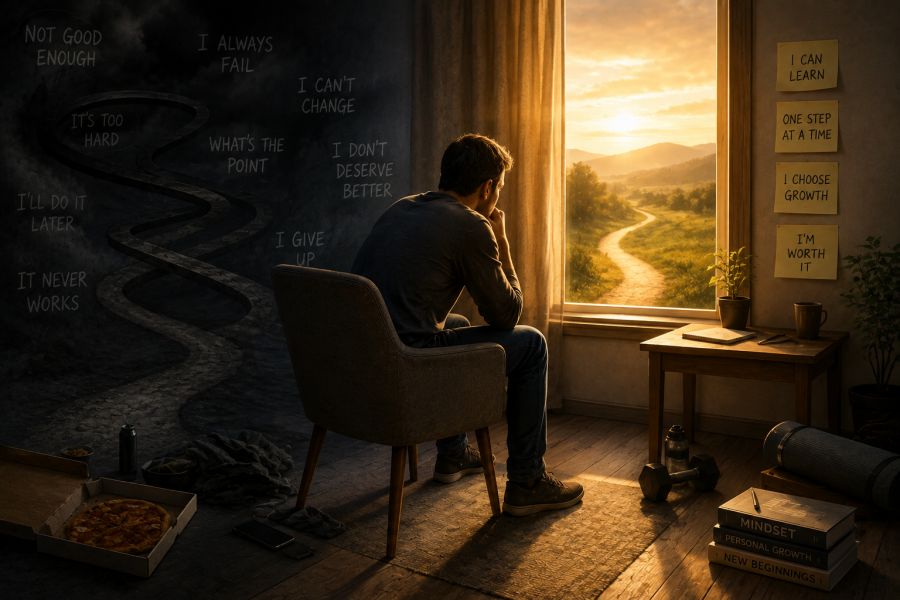
Not because you weren't serious about it. But because those few minutes of conscious decision-making are competing against a response you may have practiced for ten, twenty, or thirty years.
An old pattern does not have to be logical. It only has to be well learned.
We Don't Only Repeat What Is Good for Us
We would like to believe that people naturally seek out what is good for them. If that were true, life would be considerably easier.
In reality, we often repeat what our minds already know.
What is familiar is predictable. And predictability can create a certain sense of safety, even when the situation itself is far from pleasant.
That is why we may repeatedly find ourselves in similar relationships. React the same way during conflict. Postpone the same things. Constantly try to please others or avoid situations in which we might be judged.
From the outside, it may seem completely irrational.
But when viewed through the lens of our past, it can sometimes make surprisingly good sense.
What If Your Bad Habit Is Actually Helping You?
That may sound strange.
If a behavior is hurting us, why would we continue doing it?
Because today's problem may once have been the solution to a different problem.
A child who learned to always be good and please everyone may have discovered that doing so brought more acceptance and fewer conflicts.
Someone who avoids confrontation may have learned at some point that conflict means danger.
Another person may use food, their phone, work, or some other distraction as a quick way to temporarily avoid feeling stress, loneliness, or tension.
And perfectionism? That can be a very effective attempt to avoid criticism.
The behavior may eventually become a problem. But its original purpose may have been completely understandable.
So before you start hating yourself for a bad habit, try to discover what that habit is doing for you.
What Happens Just Before You Do It?
If we want to change a repeating pattern, it can be useful to stop focusing only on the behavior itself.
The moment immediately before it is often much more interesting.
What happened a few seconds or minutes before you once again did the thing you did not want to do?
Was there stress? Boredom? A feeling of rejection? Criticism? Uncertainty? Loneliness?
What did you say to yourself at that moment?
And what did you feel in your body?
This is often where we discover the real trigger.
The behavior itself may simply be the final link in a much longer chain.
The Trigger Doesn't Have to Look Important
Sometimes it is surprising how little it takes to activate an old pattern.
A particular facial expression. A tone of voice. A single sentence. The feeling that someone is ignoring us. An email from a particular person. Silence after a message when we expected a reply.
The present situation itself may be completely harmless. But our mind can connect it with something it already knows.
And within moments, not only the memory but also the way we once learned to respond can become activated.
In FasterEFT, Robert Gene Smith works with these internal references. It is not only about what is happening around us, but also about what the situation means to our mind.
"That's Just the Way I Am"
The longer we repeat a particular pattern, the easier it becomes to confuse it with our personality.
"I'm just hot-tempered."
"I can't say no."
"I always leave everything until the last minute."
"I always choose the wrong partner."
"I have no discipline."
But there is an enormous difference between saying "That's who I am" and "I learned to respond this way."
The first sounds like a sentence handed down by a judge.
The second opens the possibility of change.
If something is a learned response, it is not necessarily an unchangeable part of who we are. It is a strategy that our mind adopted at some point because it seemed useful.
Why Simply Removing the Behavior May Not Be Enough
Imagine someone who spends several hours every evening mindlessly scrolling through their phone.
They decide to delete the apps.
Problem solved?
Perhaps. But if the phone was being used as a way to avoid feeling tension after a difficult day or thinking about personal problems, deleting an app does not remove the need that the behavior was satisfying.
They may start watching television instead. Eating. Working late into the night. Or finding another way to avoid the same feeling.
The form has changed.
The function remains.
That is why it can be important not only to ask, "How do I stop doing this?"
But also, "What does this give me?"
You Don't Have to Hate Your Old Reactions
When we discover our own repeating patterns, it is easy to start criticizing ourselves for them.
How could I have been so stupid? Why did I do it again? Why do I never learn?
But doing this creates another unpleasant emotional state that our mind then has to deal with.
Curiosity can be far more useful.
Where did I learn this?
When did responding this way help me?
What am I trying to avoid?
What do I believe would happen if I responded differently this time?
These questions are not about making excuses. They help us understand the mechanism we are trying to change.
What If You Don't Do What You Usually Do This Time?
There is a simple way to uncover something interesting.
Choose one of your repeating patterns and imagine that next time, you simply don't follow it.
If you always give in, imagine saying no this time.
If you immediately become defensive during conflict, imagine remaining calm.
If you keep postponing an important task, imagine opening it right now.
Then notice your reaction.
What appears?
Tension? Fear? Guilt? An image of conflict? The worry that you will disappoint someone?
That reaction may be exactly why the old pattern is still alive.
This Is Where FasterEFT Can Come In
Once we discover the emotional response connected to changing the pattern, we finally have something specific to work with.
Using tapping and other FasterEFT principles, we can focus on the images, memories, internal statements, and physical sensations that support the old behavior.
The goal is not to command ourselves, "I will never do this again."
It is about changing what happens inside us when the familiar trigger appears.
If the same situation no longer produces the same emotional response, something can become available that we may not have had before.
The ability to choose a different response.
Space Can Appear Between the Impulse and the Reaction
Real change does not necessarily mean that we never experience the old impulse again.
At first, it may look much more subtle.
Someone says something and suddenly you notice, "Ah, this is where I would normally become defensive."
Stress appears and instead of automatically reaching for your phone, you notice what you are actually feeling.
Someone asks you for yet another favor and, before the automatic "sure" comes out of your mouth, you pause for a moment.
That brief moment matters.
Because where there used to be only an automatic reaction, there is now beginning to be a choice.
You Don't Have to Fight Yourself
Perhaps you have already tried many times to change through willpower. Stricter rules. Promises. Self-criticism. Fresh starts.
And perhaps every time, sooner or later, you ended up returning to the same behavior.
That does not necessarily mean that you lack willpower.
Perhaps you were simply trying to remove a solution without discovering what problem that solution was still solving in your mind.
Sometimes we don't need to learn how to fight ourselves. We need to understand why one part of us still believes that the old way is the best option it has.
And when we change the fear, pain, or belief that originally created the pattern, we may no longer need to overpower the old behavior every time it appears.
Perhaps, little by little, we simply stop needing it.
And that is when change stops being an endless battle between what we think we should do and what we eventually end up doing.
It begins to become a new way of living.
If you would like to explore emotional healing, personal growth, and the principles of FasterEFT more deeply, you can find additional resources and eBooks that may support your journey enter my store.